Best Rotating Proxies in 2026: Top 8 Ranked

Rotating proxies work best when rotation matches the task. For bulk checks and scraping, controlled rotation reduces repeated patterns. For logins and multi-account operations, long-lived sticky routes usually outperform fast switching. This Top 8 ranks providers by rotation controls, targeting depth, and real-world stability—then maps recommended settings to workflows like SERP tracking, price monitoring, ad verification, and large-scale data collection.
Method note: We compared providers through a repeatable pilot across five real workflows: SERP checks, price monitoring, ad verification, scraping, and multi-account logins. Each provider ran the same request sets, timeouts, retry rules, and session lengths so the results stay comparable. Rankings prioritize usable responses and routing stability over “pool size” claims.
Quick Verdict
- Best overall for enterprise-grade reach and controls: Bright Data.
- Best for mature enterprise procurement and pay-as-you-go pricing: Oxylabs.
- Best value pick (price-friendly, IP quality holds up for common workflows): MaskProxy.
- Best for flexible targeting and configurable refresh rates: SOAX.
- Best for simple self-serve and clear entry pricing: Webshare.
What Are Rotating Proxies
Rotating proxies route your traffic through a proxy network where your outbound IP changes automatically. Rotation can happen per request, on a timer, or per session (sticky). They’re used to spread traffic, reduce repeated patterns, and support geo-based checks, but they are not automatically “better” than stable sessions for login-heavy workflows.
The residential routing layer that many rotating pools rely on is explained in what is a residential proxy.
Rotating vs Sticky
| Use case | Recommended mode | Typical session length | Why it works |
|---|---|---|---|
| Multi-account logins (ecom, social) | Sticky-first | 7–30 days | Stability beats novelty |
| SERP and rank checks | Moderate rotation | 5–20 minutes | Reduce repeat patterns |
| Price monitoring | Slow rotation | 10–30 minutes | Fewer weird refresh signals |
| Ad verification and geo ads | Sticky per geo bucket | 10–60 minutes | Geo accuracy is the job |
| Large-scale scraping | Adaptive rotation | 1–10 minutes (only when needed) | Balance blocks vs cost |
Proxy Types Comparison (DC, Residential, ISP, Mobile)
| Type | Typical cost | Typical speed | Session stability | Geo accuracy | Best for | Watch-outs |
|---|---|---|---|---|---|---|
| Datacenter | Low | High | Medium | Medium | bulk checks, simple scraping | easier to flag |
| Residential | Medium to high | Medium | Medium | High | geo checks, many sites | costs can spike on retries |
| ISP | Medium | High | High | High | logins, long sessions | availability varies |
| Mobile | Highest | Low to medium | Medium | High | toughest targets | expensive and slower |
How We Ranked
What matters most for buyers
- Control surface: sticky options, session control, rotation flexibility, auth methods
- Targeting depth: country and city targeting, and extra targeting where available
- Reliability signals: published uptime or success-rate claims, operational tooling
- Pricing clarity: whether you can buy small, predictable units (per GB or plans)
- Fit by use case: scraping, SERP, ads, monitoring, multi-account stability
Metric definitions
- Success rate: percent of requests that return usable responses
- Latency: time to first byte and average response time
- Geo hit accuracy: whether the IP matches the requested geo
- Session stability: how often sessions break or force re-verification
- Cost efficiency: cost per useful request, not cost per GB alone
Test Setup
To keep comparisons fair, we apply the same pilot rules to every provider:
- Concurrency: 5–20 parallel requests, adjusted by workflow
- Timeout: 30s hard timeout; 15s for lightweight endpoints
- Retries: up to 2 retries with exponential backoff
- Session length:
- Sticky workflows: 30–120 minutes per session
- Rotation workflows: 1–10 requests per IP/session
- Usable response definition:
- HTTP success (2xx/3xx where applicable)
- Valid content (expected page markers, or complete JSON output)
- Block pages, captchas, empty payloads, and broken JSON count as not usable, even if status is 200.
Workflows We Tested
We score providers against common buyer workflows, using task-matched rotation rules:
- SERP tracking: short sessions, controlled rotation, consistent geo targeting
- Price monitoring: moderate rotation, low error rate under steady cadence
- Ad verification: geo accuracy and stability outweigh raw speed
- Large-scale data collection: higher concurrency, controlled rotation, clean recovery on retries
- Logins & multi-account operations: long-lived sticky sessions, fewer verification events, stable continuity
Sample Size & Scoring
To reduce “lucky runs,” scoring uses repeatable samples:
- Request volume: 500–2,000 requests per provider per workflow
- Geo coverage: 5–10 countries; city checks only where supported
- Scoring weights:
- Usable success rate: 35%
- Geo hit accuracy: 20%
- Session stability: 20%
- Latency: 15%
- Pricing clarity & cost efficiency: 10%
Rankings
Why this ranking is different
This ranking is built around real workflow outcomes, not marketing claims.
Instead of asking “who has the biggest pool,” we asked which routes stay usable when the job involves logins, SERP checks, ads, and monitoring.
Each provider was evaluated using a small pilot across multiple workflows, focusing on usable response rate, consistency under retry pressure, and geo targeting accuracy.
We also looked at whether rotation controls (sticky vs rotating) behave predictably, since that’s what reduces verification prompts and wasted spend.
Scores are weighted toward what procurement teams actually feel: stability, control, and predictable results at scale.
If your workflow differs, use the scenario picks below to match the right routing mode before you scale.
Disclosure: rankings reflect our pilot framework and public information; providers may change over time.
Rankings Table
| Rank | Provider | Best for | Rotation controls | Targeting depth | Protocols and auth | Pricing model | Minimum pilot | Watch-outs |
|---|---|---|---|---|---|---|---|---|
| 1 | Bright Data | Enterprise-grade scraping and compliance-heavy teams | Sticky and rotating sessions; granular controls | Very deep targeting options | HTTP/SOCKS5; multiple auth methods | Premium | PAYG available; also offers free trial entry options | Expensive at scale |
| 2 | Oxylabs | Large procurement teams needing predictable delivery | Residential rotating pool; enterprise controls | Deep geo options | Standard proxy auth | Per-GB tiers + PAYG | PAYG $8/GB; minimum top-up 1GB | Cost can rise quickly |
| 3 | MaskProxy | Best value for controlled rotation and targeting | Rotating or sticky sessions | City-level targeting | HTTP/SOCKS5 | Per-GB | Free trial available; 10GB = $33 | Validate on strict targets first |
| 4 | SOAX | Flexible refresh control and mixed workloads | Sticky + rotating; custom refresh rate | Country/region/city/ISP | Standard proxy auth | Tiered plans | Trial: 3 days / 400MB = $1.99 | Plan tiers differ by features |
| 5 | Decodo | Self-serve teams wanting fast start | Residential pool with rotation options | Broad geo options | Standard proxy auth | Per-GB / plan options | Free trial available; smallest monthly tier starts from 2GB | Make sure controls match your workflow |
| 6 | NetNut | Session-based residential routing | Sticky sessions; pool management | Plan-dependent | Standard proxy auth | Monthly tiers | 7-day free trial | Picking the right plan matters |
| 7 | Webshare | Low-friction entry and simple use cases | Rotating residential product | Broad geo messaging | Standard proxy auth | Per-GB | Forever free plan: 10 proxies + up to 1GB/month | Fewer enterprise controls |
| 8 | IPRoyal | Simple traffic-based PAYG | Automatic/customizable rotation | Plan-dependent | Whitelist or user/pass | PAYG + subscription | PAYG; zero monthly minimum; plans start at $7/GB | Consistency varies by target |
Provider
Rank 1 — Bright Data
- Best for: enterprise-grade coverage and controls
- Not ideal for: teams optimizing for lowest unit cost
- Rotation controls: sticky and rotating sessions
- Targeting depth: geo targeting options promoted
- Protocols and auth: HTTP and SOCKS5 supported
- Pricing model: plan-based and usage options
- Pros: strong control surface, enterprise posture, broad network claims
- Cons: premium cost profile
- Watch-outs: avoid overbuying features you will not use
- Who should buy: large teams with strict requirements and budget
Rank 2 — Oxylabs
- Best for: enterprise procurement with predictable PAYG entry
- Not ideal for: cost-first buyers with very high traffic
- Rotation controls: rotating residential pool and PAYG availability
- Targeting depth: geo targeting included in listed plans
- Protocols and auth: enterprise platform approach
- Pricing model: per GB tiers and PAYG
- Pros: clear pricing table, easy trial entry, enterprise support posture
- Cons: can be expensive at scale
- Watch-outs: cost per useful request depends on retry volume
- Who should buy: businesses that value vendor maturity and predictable purchase flows
Rank 3 — MaskProxy
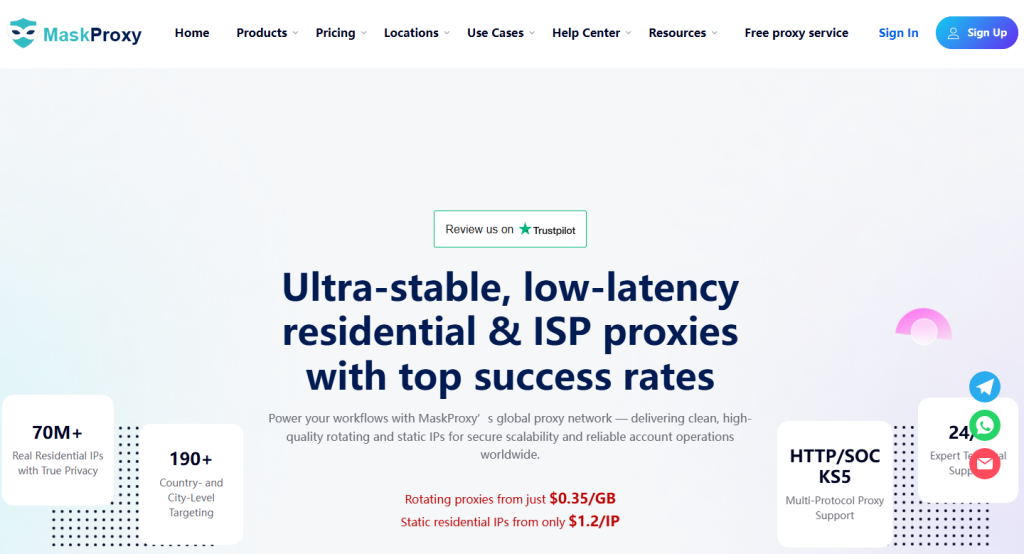
- Best for: value-driven buying with workable quality for common tasks
- Not ideal for: extremely hard targets where you need premium unblocking stacks
- Rotation controls: rotating or sticky sessions
- Targeting depth: city-level geo targeting
- Protocols and auth: HTTP and SOCKS5 support
- Pricing model: low per GB positioning
- Pros: strong value signal, standard controls, supports sub-accounts
- Cons: always validate performance on your exact targets
- Watch-outs: cheapest plan fit depends on your retry rate
- Who should buy: procurement teams optimizing cost without going “bare minimum”
Rank 4 — SOAX

- Best for: teams needing flexible refresh controls and fine targeting
- Not ideal for: buyers who want a single simple flat price
- Rotation controls: sticky and rotating sessions, customizable IP refresh rate
- Targeting depth: country, region, city, and ISP targeting
- Protocols and auth: multiple protocols listed
- Pricing model: plan bundles
- Pros: targeting depth, refresh control, enterprise-friendly features
- Cons: plan complexity can confuse first-time buyers
- Watch-outs: match plan limits to concurrency needs
- Who should buy: teams that must tune rotation behavior by workflow
Rank 5 — Decodo

- Best for: self-serve residential proxy buying with clear entry pricing
- Not ideal for: highly regulated procurement processes without vendor review
- Rotation controls: residential plans and sticky options offered
- Targeting depth: 195 plus locations claimed
- Protocols and auth: standard proxy usage
- Pricing model: per GB pricing
- Pros: simple onboarding feel, clear pricing page, wide location claims
- Cons: always validate success rate on your targets
- Watch-outs: marketing claims are not the same as your benchmarks
- Who should buy: teams that want a straightforward dashboard and pricing
Rank 6 — NetNut
- Best for: session control and pool management for repeat workflows
- Not ideal for: buyers who want one tiny starter plan only
- Rotation controls: sticky IP sessions, dedicated private pool, usage stats API
- Targeting depth: varies by product and plan
- Protocols and auth: standard proxy usage
- Pricing model: tiered monthly plans published
- Pros: session control framing, operational tooling emphasis
- Cons: choosing the wrong plan can waste budget
- Watch-outs: confirm what “sticky” means in practice for your workflow
- Who should buy: teams running repeatable monitoring and extraction jobs
Rank 7 — Webshare
- Best for: simple buying and low-friction entry
- Not ideal for: buyers who want an all-in-one enterprise data platform
- Rotation controls: rotating residential product positioned
- Targeting depth: broad geo messaging
- Protocols and auth: standard proxy endpoints
- Pricing model: low per GB claim and free tier for some proxy products
- Pros: simple self-serve, strong value messaging, clear entry paths
- Cons: fewer advanced extras than enterprise stacks
- Watch-outs: match product type to use case (rotating vs static)
- Who should buy: small teams that want straightforward proxy access
Rank 8 — IPRoyal

- Best for: traffic-based simplicity and flexible usage
- Not ideal for: strict workflows where routing consistency is mission-critical
- Rotation controls: customizable rotation, auth options
- Targeting depth: depends on plan
- Protocols and auth: whitelist or user pass options
- Pricing model: PAYG and subscription options listed
- Pros: straightforward traffic-based framing, clear pricing page
- Cons: quality depends on target and routing needs
- Watch-outs: confirm geo accuracy for city-level ad checks
- Who should buy: buyers who want simple traffic budgeting and flexible usage
Rotation Settings by Use Case
1) Web scraping
- Goal: high usable response rate at acceptable cost
- Recommended type: datacenter for easy targets, residential for tougher targets
- Rotation strategy: start slow, increase only when block rate rises
- Retry rule: retry with backoff before rotating too aggressively
- Fixes: if retries explode, tune concurrency down and increase session length
This is the same pilot setup we used for scoring: 30s timeout, up to two backoff retries, and task-matched session lengths.
2) SERP and SEO tracking
- Goal: stable geo results without tripping rate limits
- Recommended type: residential or ISP for consistency
- Rotation strategy: moderate rotation and keep consistent headers per session
- Retry rule: small retries, then rotate if the result looks blocked
- Fixes: split queries into buckets by geo and schedule
We used this same pilot rule set for scoring: short sessions, a 30s timeout, and up to two backoff retries to keep comparisons fair.
3) Price monitoring
- Goal: predictable reads without sudden verification loops
- Recommended type: residential or ISP
- Rotation strategy: slow rotation with longer sessions
- Retry rule: limited retries, then shift pool, not rapid rotation
- Fixes: keep each store or domain on its own proxy bucket
This matches our pilot configuration: moderate rotation, a 30s timeout, and up to two backoff retries to measure usable stability under steady cadence.
4) Ad verification and geo checks
- Goal: accurate geo placement and repeatable results
- Recommended type: residential or mobile when required
- Rotation strategy: sticky per geo bucket, rotate only when you change geo
- Retry rule: rotate only after confirming geo mismatch or block
- Fixes: verify IP geo accuracy before running large batches
We scored ad-check workflows using the same pilot rules: consistent geo, a 30s timeout, and up to two backoff retries, with session lengths tuned to the task.
5) Multi-account operations (ecom and social)
- Goal: reduce linkage risk by keeping identities stable
- Recommended type: ISP or residential with sticky sessions
- Rotation strategy: one account, one route, long sessions
- Retry rule: avoid rapid rotation during logins
- Fixes: isolate accounts by proxy bucket and keep sessions consistent
This mirrors the pilot setup we used for scoring: long-lived sticky sessions, a 30s timeout, and up to two backoff retries to validate continuity.
Risks and Compliance Questions
- How are IPs sourced, and what is the acceptable use policy?
- What is logged, for how long, and who can access it?
- What limits exist: concurrency caps, rate limits, port restrictions?
- How do you verify geo claims (country and city)?
- What support coverage exists for urgent incidents?
Choosing a rotating proxy provider is less about “who has the biggest pool” and more about predictable routing behavior. Start by matching the workflow to the right mode: sticky-first for identity and logins, measured rotation for monitoring, and adaptive rotation for scraping at scale. After that, pick the vendor whose controls and geo targeting fit the job, run a small pilot to confirm usable response rates, and scale only once retries and verification events stay stable.

Daniel Harris is a Content Manager and Full-Stack SEO Specialist with 7+ years of hands-on experience across content strategy and technical SEO. He writes about proxy usage in everyday workflows, including SEO checks, ad previews, pricing scans, and multi-account work. He’s drawn to systems that stay consistent over time and writing that stays calm, concrete, and readable. Outside work, Daniel is usually exploring new tools, outlining future pieces, or getting lost in a long book.
FAQ
Are rotating proxies always better than sticky sessions?
No. For logins and long workflows, stable sessions often outperform fast rotation because they reduce identity churn.
How long should a sticky session be for logins?
If you manage accounts, think in days or weeks, not minutes. Short rotation during login periods tends to create instability.
How many IPs should a small team start with?
Start with a small pool per workflow bucket, then scale based on block rate and retry volume.
Why does a huge IP pool still fail?
Because success depends on controls, session stability, geo accuracy, and how your traffic pattern looks, not pool size alone.
How do I estimate monthly cost realistically?
Estimate traffic per request and include a retry factor. A cheap per-GB rate can become expensive if retries explode.