Brazil proxy workflows to steady cross-region platform access

Operators managing Brazil-focused accounts from outside the country often hit silent friction: inconsistent login regions, unstable sessions, and aggressive OTP prompts. These issues often appear as slower verification loops or delayed message actions during heavier traffic windows. A reliable brazil proxy becomes the foundation for keeping identity signals aligned when scaling day-to-day tasks.
Why operators need stable Brazil routes for account operations
Teams handling 20–50 Brazil-facing identities usually discover the same pattern: platforms rarely show explicit warnings, but backend scoring tightens when region signals fluctuate. A login from São Paulo at noon followed by a jump to Europe minutes later can push accounts into “soft review mode,” even when the interface looks normal.
Two common pain points stand out:
- Soft region checks
Brazil platforms correlate IP region, time zone, and browser locale. If one element drifts, accounts begin receiving more micro-verifications or subtle rate limits. - Session volatility
A rotating route switching mid-action—during a checkout, message send, or onboarding—feels abnormal from a risk-engine perspective.
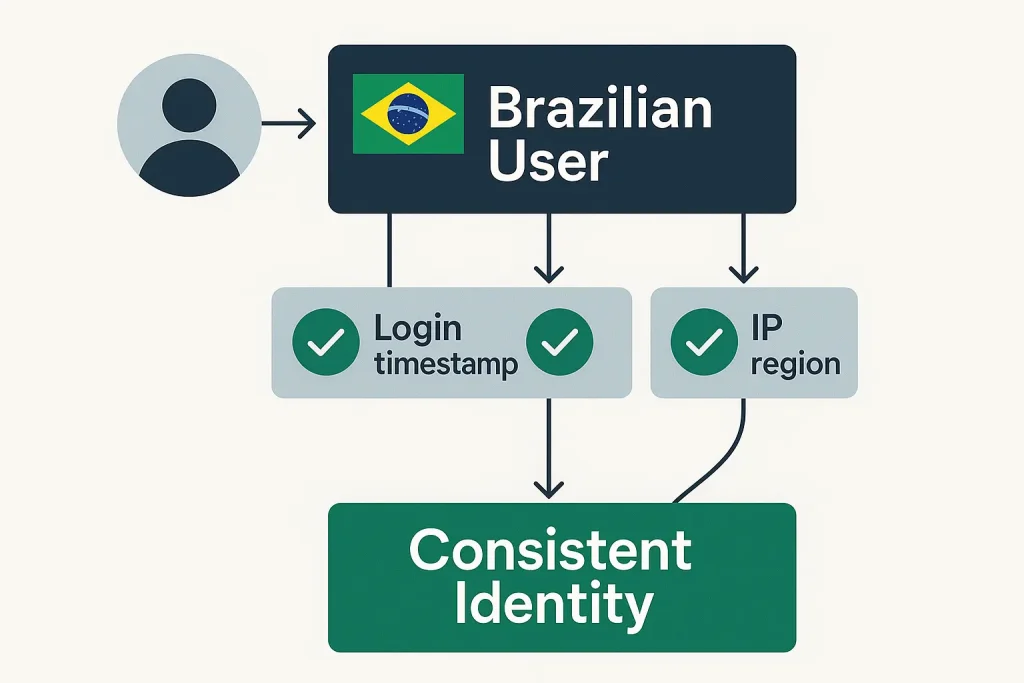
Teams that route all login, warm-up, and user interactions through a single Brazil path typically see fewer OTP spikes once identity pools exceed a few dozen profiles.
Choosing the right Brazil proxy setup for multi-account and data tasks
A single route rarely serves every requirement. Brazil workflows usually split into three operational categories:
1. Long-session identity operations
Profile edits, messaging, and identity verification typically run smoother on a static Brazil IP. It preserves continuity and avoids surprising the platform with an unexpected rotation mid-flow.
2. High-frequency data fetching
Product updates, local SERP checks, or price monitoring benefit from controlled rotation, but rotation windows must be realistic. Many Brazil endpoints detect overly frequent changes—even 10-second swaps can trigger dampened response behavior.
3. Mobile-signal-sensitive tasks
App-only platforms sometimes respond more consistently to mobile ASNs. This doesn’t apply to every scenario, but teams doing onboarding on app-centric services sometimes keep a dedicated mobile route pool.
A practical rule operators rely on is:
If the task creates or edits user-generated actions, use persistence; if it reads data at scale, use measured rotation.
To keep behaviors predictable, many teams rely on a stable regional access route like regional access routing to keep platform scoring aligned with expected Brazil geography.
Building a clean connection chain to prevent mismatched fingerprints
Even a perfect connection fails when environment fingerprints don’t match geography. Three alignment points matter most:
- IP region ↔ browser locale
If your IP is Brazil but your browser speaks English or German, some platforms quietly escalate the risk score. - Time zone alignment
Brazil services often compare login time to device time. A multi-hour mismatch creates a detectable inconsistency. - Device fingerprint consistency
Reusing a single IP across fingerprints or switching fingerprints without justification can look manufactured.
A reliable alignment chain:
- Brazil static or measured-rotation route
- Browser locale set to pt-BR
- System clock aligned to BRT
- One identity → one environment (no cross-mixing)
Teams maintaining 40–60 identities report 30–40% fewer OTP prompts during the first warm-up week when all three elements (locale, IP, time zone) are synchronized—an observation repeated across multiple operator groups.
Step-by-step setup flow for preparing a Brazil-focused environment
The strongest results usually come from a repeatable preparation routine. Below is a more detailed actionable flow.
1. Configure and verify the proxy client
- Bind your Brazil endpoint and test authentication.
- Confirm that the ASN belongs to a Brazil carrier relevant to your workflow.
- Check for WebRTC leaks before launching any browser profile.
- Common mistake: some systems auto-restore DNS or proxy bypass rules after reboot; operators should verify these settings didn’t revert.
2. Validate geolocation, DNS, and leak surfaces
- Use IP info tools to confirm city and ASN match.
- Confirm DNS paths resolve through the same region; mixed DNS often creates risk spikes.
- Disable system-level caching tools that may expose your home region.
3. Run a three-point warm-up check
- Load basic non-login pages from your target platform.
- Execute a simple search or navigation to test latency stability.
- Keep the environment idle for 40–60 seconds to confirm the route doesn’t rotate unexpectedly.
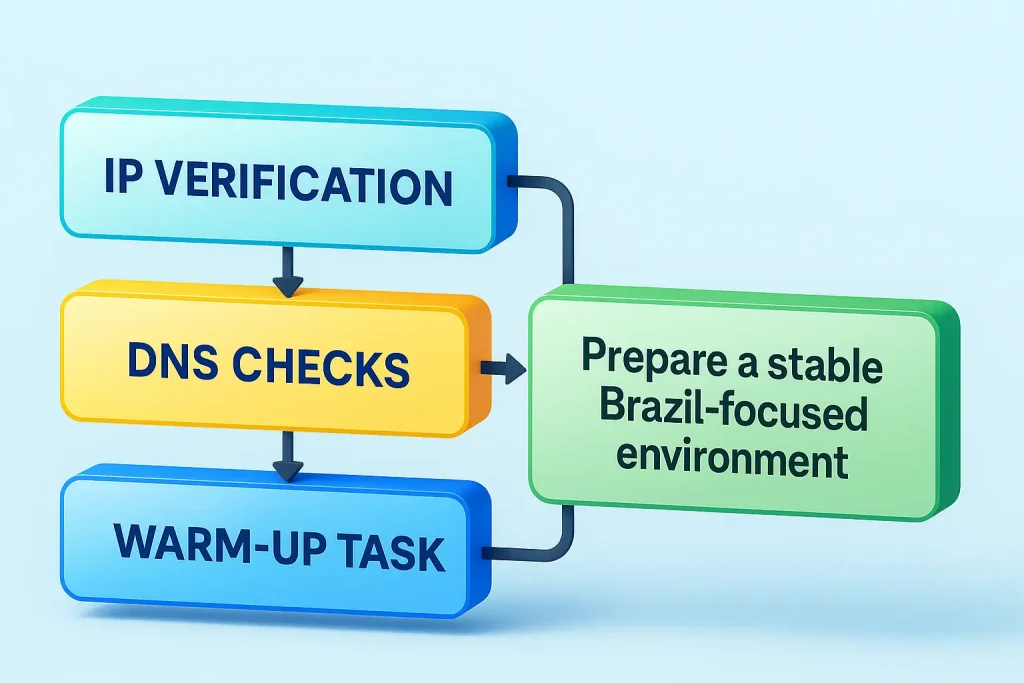
Operators often forget DNS alignment; yet it’s among the most frequent causes of inconsistent early-stage behavior during account warm-up.
Scaling Brazil-facing operations while reducing account friction
Scaling from a handful of accounts to 50+ demands process control more than raw bandwidth. Common practices include:
- Batching tasks by region group
Assign each batch to a specific Brazil route so identities behave consistently. - Controlled identity pools
Avoid mixing freshly created accounts with aged profiles on the same IP cluster. - Ongoing behavior monitoring
Brazil platforms update anti-abuse signals periodically. A routing strategy that works in January may require adjustments by March.

Teams managing larger batches often find that a small set of predictable, clean exits performs better than a larger pool with inconsistent signals.
A low-risk next step is to run several controlled tests with 2–3 identities using a stable localized route, evaluate session steadiness for a few days, and only then scale up the workflow. Many teams bookmark a reference like regional Brazil routing to maintain consistent standards as they expand operations.