 Rotating Residential Proxies
 Rotating Datacenter Proxies
 Static Residential Proxies
 Static Datacenter Proxies
 Unlimited Rotating Residential Proxies
 Proxy Solutions
 United States Proxies
 Canada Proxies
 United Kingdom Proxies
 France Proxies
 Germany Proxies
 Singapore Proxies
 Japan Proxies
 Australia Proxies
 Vietnam Proxies
 Philippines Proxies
 India Proxies
 Mexico Proxies
 View All Regions
 Social Media
 E-commerce
 Data Aggregation
 Ad Verification
 Artificial Intelligence
 Market Research
 Integration Tools
 Contact Us
 FAQ
FAQ
 Documentation
 Tutorials
 SDK
SDK
 Affiliate Program
 Become an Agent
 Partners
 Blog
Blog


Country vs City-Level Proxies: Which One Fits Localized QA, Price Checks, and Checkout Testing?
If you are testing a localized user flow, it is easy to assume that narrower targeting is automatically better. In practice, that often leads teams to pay for city-level precision before they have proved that the workflow actually changes by city.
The short answer is this: country-level proxies are the better default for most language, currency, catalog, and broad checkout checks, while city-level proxies are worth paying for only when the result materially changes by metro area, store radius, local delivery logic, or city-specific promotions.
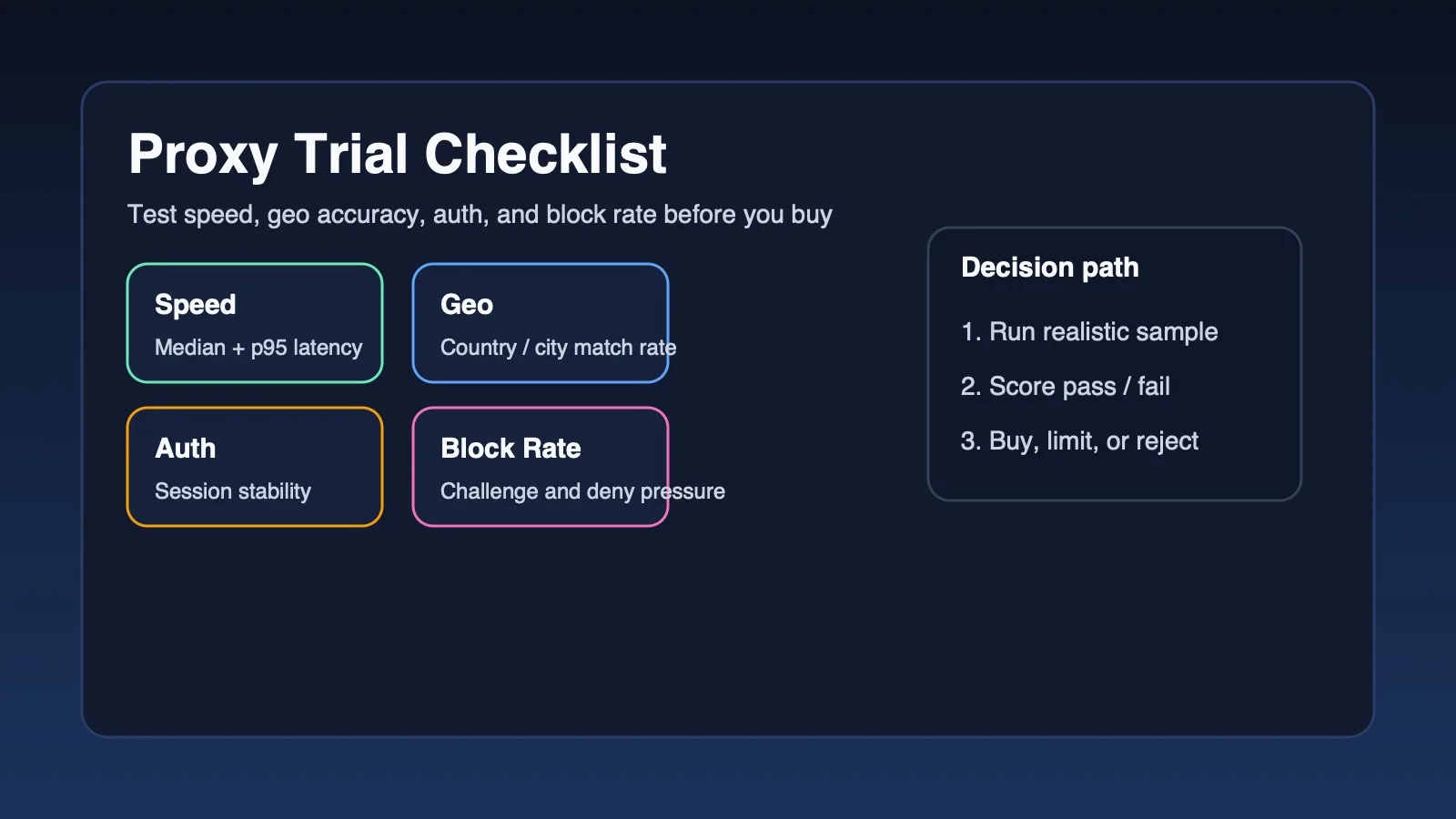
If you are still validating a provider more generally, start with the proxy trial checklist. If your access model is still unstable, fix that first with the proxy authentication checklist.
Quick answer: buy the narrowest location scope that still matches the decision you need to verify
Country-level targeting should be the default unless your workflow can prove that city precision changes a real outcome. Location precision is useful only when it improves the decision quality of your test. If your question is “Does this site show the right country catalog, language, tax treatment, or payment options?” then country-level targeting is usually enough. If your question is “Does this exact metro area see a different delivery promise, inventory state, ad creative, or fraud challenge?” then city-level targeting becomes more valuable.
That is why the right default is not “buy the most precise pool available.” The right default is “buy the narrowest scope that still matches the decision you need to trust.”
Country-level vs city-level targeting at a glance
| Targeting scope | Usually best for | What it validates well | Main tradeoff | Better default when |
|---|---|---|---|---|
| Country-level proxies | Broad localization QA, national pricing review, language and currency checks, country checkout validation | Whether the experience matches users in a given country | Can miss metro-specific differences in delivery, stock, or ad exposure | Your decision is national, not city-sensitive |
| City-level proxies | Delivery promise QA, store pickup flows, local inventory checks, city ad previews, local ranking review | Whether the experience changes across metros inside one country | Higher cost and more operational complexity | The outcome materially changes by city |
| Static city-targeted sessions | Repeat logins, multi-step checkouts, long flows that must stay in one metro | Whether a long session holds location consistency from start to finish | Less flexible than broader rotating coverage | You need continuity through a city-specific workflow |
For many teams, residential proxies are the practical starting point because they are better aligned with real-user localization checks than generic high-throughput traffic paths. If the workflow requires longer continuity, static residential proxies can be easier to validate across multi-step sessions.
When country-level proxies are usually enough
Country-level targeting is usually the correct choice when the workflow is testing broad national experience rather than fine-grained local variation. That includes:
- language and locale defaults
- tax or currency presentation
- country catalog access
- payment-method visibility
- national compliance messaging
- broad checkout-path validation
For example, if the real business question is whether a shopper in the United States sees the correct catalog and payment flow, a United States proxy is often enough. If the same review is about the Japanese localized experience as a national market, a Japan proxy is usually enough as well.
The common mistake here is confusing “more precise” with “more correct.” If the page outcome does not actually vary by city, city-level inventory only increases cost and narrows supply without improving the decision.
When city-level targeting is worth paying for
City-level targeting earns its keep when your workflow depends on a metro-specific outcome. That usually means the site or platform changes something meaningful inside the same country, such as:
- same-day or next-day delivery estimates by city
- store pickup availability by metro area
- local inventory visibility
- city-specific promotions or ad variants
- fraud friction that increases in one region but not another
- local ranking or marketplace results that differ inside one country
This is also the point where proxy type matters. If you are comparing location realism and session stability together, the decision logic from residential vs datacenter proxies still applies. Geo precision alone will not rescue a workflow that loses continuity halfway through checkout.
A 5-step decision path before you buy
- Name the exact decision you need to trust. Write it in one sentence. “Verify national pricing” and “verify city delivery promises” are different jobs.
- Check whether the outcome really changes by city. If your team cannot name a city-sensitive field, city targeting is probably premature.
- Match the session model to the workflow. Short validation bursts can tolerate broader rotation. Multi-step login or checkout checks may need a more stable session path.
- Pilot with the smallest useful scope first. Start at country level, then escalate to one or two city targets only if the workflow proves that metro precision changes the result.
- Record the pass or stop decision. If city-level testing finds no meaningful difference, move back to country-level and keep the simpler operating model.
Pre-launch checklist for geo-targeted proxy testing
- The workflow decision is written clearly enough that another teammate could repeat it.
- You know whether the page outcome changes at country scope, city scope, or both.
- The chosen proxy type matches the session length of the test.
- At least two target locations have been retested to rule out a one-off result.
- City-level targeting is being used for a proven city-sensitive behavior, not because it sounds more precise.
- The team knows when to fall back to country-level coverage to reduce cost and complexity.
If you cannot check those boxes yet, pause the larger buy. A smaller pilot is cheaper than scaling the wrong location model.
Final recommendation
Start with country-level targeting unless your workflow can prove that city precision changes a real business decision. Move to city-level targeting when metro differences affect delivery promises, inventory visibility, ad QA, or location-sensitive checkout behavior. If the workflow also needs long-lived continuity, pair that geo choice with the right session model rather than treating location as the only variable.
That keeps the buy tied to evidence instead of assumption, which is usually the difference between a useful localized QA setup and an expensive over-spec purchase.