Lazada Vietnam Proxy for Stable Logins and Multi-Store Separation

Teams running multiple Lazada Vietnam stores often run into the same pattern: logins that don’t stay stable, verification that keeps coming back, and store activity that starts to look “linked” even when operations are legitimate. A Lazada Vietnam proxy works by keeping the outbound route consistently Vietnam-bound; this relies on a Vietnam-located proxy layer, such as Vietnam proxies, to avoid location drift during routine access.
This setup is designed for teams managing multiple VN-facing stores from one office or shared cloud desktops, where correlation risk builds up across accounts even without policy abuse.
What Is a Lazada Vietnam Proxy?
A Lazada Vietnam proxy is a Vietnam-located outbound route used to access Lazada Vietnam with a consistent Vietnam network presence. In daily operations, it supports stable Seller Center sessions and reduces the chance that multiple stores end up sharing the same network “footprint.”
The practical goal is simple: each store should look like it is operated from a steady Vietnam route over time. Stability beats novelty in identity-sensitive work.
A Lazada Vietnam proxy is not “random IP switching.” It is also not the same as a VPN when you manage multiple stores, because the real risk comes from correlation across stores, not just visibility of a single IP.
What it is: a Vietnam-bound route you keep consistent for identity-sensitive actions.
What it is not: “random IP switching.”
Also not: a shared VPN hop when you operate multiple stores.
Why Seller Logins Become Unstable in Lazada Vietnam
Unstable logins usually show up as repeated 2FA prompts, frequent logouts, “unusual activity” warnings, or sessions that reset after routine actions like listing edits and ad changes.
Multi-store teams trigger more checks because operations concentrate. Shared office networks, shared cloud desktops, and coordinated working hours can create a tight cluster of activity from one outbound route.
Store linking typically escalates when several of these signals happen together:
- Multiple stores using the same exit route for identity work
- Route volatility, where the city or upstream network changes too often
- Reusing the same browser profile or device context across stores
- Mixing rotation into login flows
- Bulk actions executed across stores within the same short time window

In practice, instability usually comes from one of three buckets: shared identity exits, route volatility, or profile/device reuse. Fixing any one bucket helps, but fixing all three is what stops repeated challenges.
When the route changes too much, the platform has to re-evaluate trust. That re-evaluation is what often looks like “random” verification.
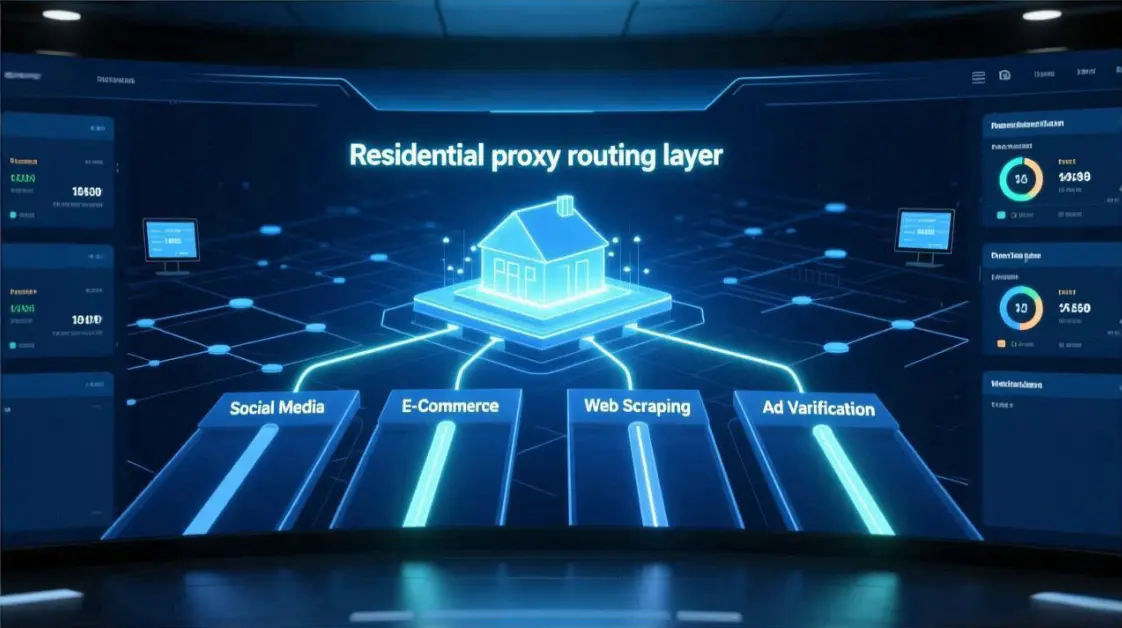
Identity Routes vs Data Routes
A stable setup starts with one rule: separate identity routes from data routes.
Identity routes work best when the network path remains unchanged over time, which is why a static residential proxy layer is commonly used for login-bound actions, such as static residential proxies.
Data routes are different. Public catalog checks, price monitoring, and research can tolerate carefully managed rotation, as long as the rotation policy is controlled and does not leak into identity work.
A clean operating rule keeps teams out of trouble:
If an action changes account state, keep the route stable. If it only reads public data, rotate with limits.
A quick test: if the action can affect payouts, ownership, permissions, ads budget, or enforcement risk, treat it as identity work.
This separation also makes troubleshooting faster. If identity actions and data actions share the same pool, every spike looks the same—and every fix becomes guesswork.
Choosing Vietnam Proxy Types for Lazada Tasks
The right proxy type depends on what the workflow touches.
Static residential (Vietnam) fits identity routes. It’s the simplest way to keep sessions consistent, especially for stores that need long-lived logins and repeated daily access.
ISP-grade Vietnam routes are useful when you need tighter stability characteristics, such as less volatility across upstream networks, while still keeping the route Vietnam-bound.
Rotating residential (Vietnam) fits data routes when you set clear limits. Rotation should be slow enough to avoid sudden route churn, and concurrency should be capped so requests don’t look like coordinated bursts. This is the same class of edge controls described in rate limiting rules.
For public, read-only tasks, a separate rotating pool is typically applied, often implemented through rotating residential proxies with strict rotation and concurrency limits.
Datacenter (Vietnam) can be “good enough” for low-risk, non-login tasks, but it becomes risky when used for identity actions. If you see more verification when datacenter routes touch Seller Center, treat that as a sign to move identity work back to a stable residential/ISP route.
A simple mapping that holds up in real operations:
- Seller Center login, payouts, permissions → stable Vietnam route
- Listing edits and ads account changes → stable Vietnam route
- Public SKU monitoring and price checks → dedicated rotating pool with limits
- Research bursts and scraping-like behavior → rotation + rate limits + clear separation from logins
| Lazada task | Route decision |
|---|---|
| Seller Center login, payouts, permissions | stable Vietnam route |
| Listing edits and ads account changes | stable Vietnam route |
| Public SKU monitoring and price checks | dedicated rotating pool with limits |
| Research bursts and scraping-like behavior | rotation + rate limits + clear separation from logins |
Why this row needs limits: Bursty research traffic is often evaluated by request volume inside a short time window.
Multi-Store Separation Setup
A reliable multi-store pattern is: one store ↔ one browser profile ↔ one Vietnam identity route. This prevents accidental cross-touching where two stores inherit the same cookies, fingerprints, or outbound route.
Start by assigning ownership boundaries. Each store should have named operators and a clear rule for who can access it and from which profile. Shared access is possible, but sharing should stay within the same store, not across stores.
Proxy assignment rules that reduce store linking:
- No sharing identity routes across different stores
- Keep identity routes stable for each store over time
- Use a separate rotating pool only for public data tasks
- Avoid switching a store’s identity route right after a sensitive change
Daily operating rules matter as much as the route:
- Keep login windows consistent and avoid sudden midnight access spikes
- Don’t run the same bulk action across many stores at the same minute
- Treat payouts, security, and permissions as change-controlled actions
Track the setup with a lightweight log. A spreadsheet is enough: store ID, profile ID, route ID/segment, operator, and last change date. When something breaks, this log is usually the fastest way to find the cause.
| Store ID | Profile ID | Route ID / segment | Operator | Last change date | Notes |
|---|---|---|---|---|---|
Wrap-Up: Validate Stability and Scale Safely
A stable Lazada Vietnam proxy setup shows up in outcomes:
- Fewer verification prompts during normal working hours
- Sessions that last 7–14 days without surprise re-auth
- Sensitive actions that stop triggering extra checks
- A clean separation pattern where incidents stay isolated to one store, not the whole group

If verification suddenly spikes, pause sensitive actions first, keep the identity route stable, and roll back to the last known-good route rather than “trying random IPs.” A cool-down window plus stable routing typically resolves more than aggressive switching.
- Pause payouts, security, permissions, and ads budget changes.
- Keep the current identity route stable (do not test random IPs).
- Verify the binding map: correct store ↔ profile ↔ identity route.
- Move monitoring/research traffic back to the data pool (never identity).
- Roll back to the last known-good identity route and hold a cool-down window before sensitive actions.
When scaling from three stores to ten or more, the priority is not more rotation. It’s more stable identity routes, stricter profile boundaries, clearer operator ownership, and tighter change-control for sensitive actions. As operations expand, Lazada-specific routing patterns become easier to reason about when viewed in the context of Lazada proxies rather than generic proxy categories.

Daniel Harris is a Content Manager and Full-Stack SEO Specialist with 7+ years of hands-on experience across content strategy and technical SEO. He writes about proxy usage in everyday workflows, including SEO checks, ad previews, pricing scans, and multi-account work. He’s drawn to systems that stay consistent over time and writing that stays calm, concrete, and readable. Outside work, Daniel is usually exploring new tools, outlining future pieces, or getting lost in a long book.
FAQ
Q1: Do I need a Vietnam proxy for Seller Center logins?
A: Yes—use a stable Vietnam route for logins, payouts, security, and permissions.
Q2: When should I use rotating Vietnam proxies?
A: For public, read-only tasks (SKU/price checks). Keep rotation slow and cap concurrency.
Q3: Are Vietnam datacenter routes OK?
A: Only for low-risk, non-login work. If Seller Center triggers extra checks, switch back to stable residential/ISP.
Q4: What does “one store ↔ one profile ↔ one route” solve?
A: It reduces cross-store linking from shared cookies, profiles, or exits.
Q5: What should I do if verification spikes?
A: Pause sensitive actions, keep the identity route stable, and roll back to the last known-good route.
Q6: How many Vietnam identity routes per store?
A: Start with 1 primary + 1 backup (kept separate from any rotating data pool).