Unlimited Residential Proxies: What “Unlimited” Usually Means Before You Buy

If you are comparing unlimited residential proxies, the short answer is this: unlimited usually describes the billing model, not every operating limit that affects results.
A provider may remove per-GB charging and still keep meaningful boundaries around concurrency, session duration, gateway throughput, geo depth, or fair-use enforcement. That is why the smartest buyer question is not “is this really unlimited?” It is “which constraint shows up first when I run my real workload?”
If you are still choosing between proxy categories, compare residential vs datacenter proxies first. If you already have vendors on a shortlist, pair this article with the proxy trial checklist so you can validate the claim under live conditions.
Unlimited rarely means unlimited in every dimension
With residential proxy plans, providers often remove one billing limit while leaving several operational limits in place.
- how many concurrent threads you can run
- how many ports or gateways you can use at once
- how long a sticky session stays stable
- how much sustained throughput a pool can absorb before quality drops
- which targets trigger rate shaping, forced rotation, or support review
That does not make the offer misleading by default. It does mean the headline is incomplete unless the provider also explains the operating boundaries.
This matters most when your workflow depends on long sessions, strict geo targeting, or high parallelism. In those cases, the hidden limit matters more than the pricing label.
What providers still limit on “unlimited” plans
The usual pattern is simple: one resource becomes unmetered, and another resource becomes the real bottleneck.
| Resource area | What buyers often assume | What usually happens in practice |
|---|---|---|
| Bandwidth | No hard traffic concern at all | Bandwidth billing may disappear, but fair-use review can still appear under sustained volume |
| Concurrency | Run as many threads as you want | Port count, account caps, or gateway stability usually create a practical ceiling |
| Sessions | Sticky sessions can last as long as needed | Session TTL may still be short or unstable under load |
| Geo targeting | Every city and ASN claim stays equally available | Precision can vary by region, time, or pool depth |
| Targets | All sites behave the same under load | Sensitive targets may trigger faster rotation, denials, or support review |
This is why it helps to review the provider’s broader residential proxies offering, not just the hero plan page. The label alone tells you less than the operating behavior.
Myth vs reality: how unlimited claims usually translate in production
| Marketing claim | Buyer-friendly interpretation | Reality check |
|---|---|---|
| Unlimited residential proxies | I can scale traffic without thinking about limits | You still need to know concurrency, throughput, and session-control limits |
| Unlimited bandwidth | There is no practical usage ceiling | Billing may be unmetered while fair-use thresholds still protect the pool |
| Unlimited sessions | I can keep long-lived identities as needed | Sticky duration and clean session reuse often remain limited |
| Unlimited locations | Any country, region, or city is always available | Availability depth changes by market, and precision may be uneven |
| Unlimited usage for scraping | The plan is safe for any automation pattern | Target sensitivity, retry behavior, and support policy still decide viability |
A better way to read these claims is to turn them into testable questions:
- How many concurrent workers can this plan hold before quality drops?
- What sticky-session duration is realistic under my workload?
- Which targets are explicitly supported, rate-shaped, or reviewed?
- What happens when I sustain traffic for 30 to 60 minutes instead of 3 minutes?
- Which geo claims are contractual, and which are best-effort?
That framing gives you something you can validate instead of a slogan you can only debate.
A quick checklist to validate an unlimited plan before you commit
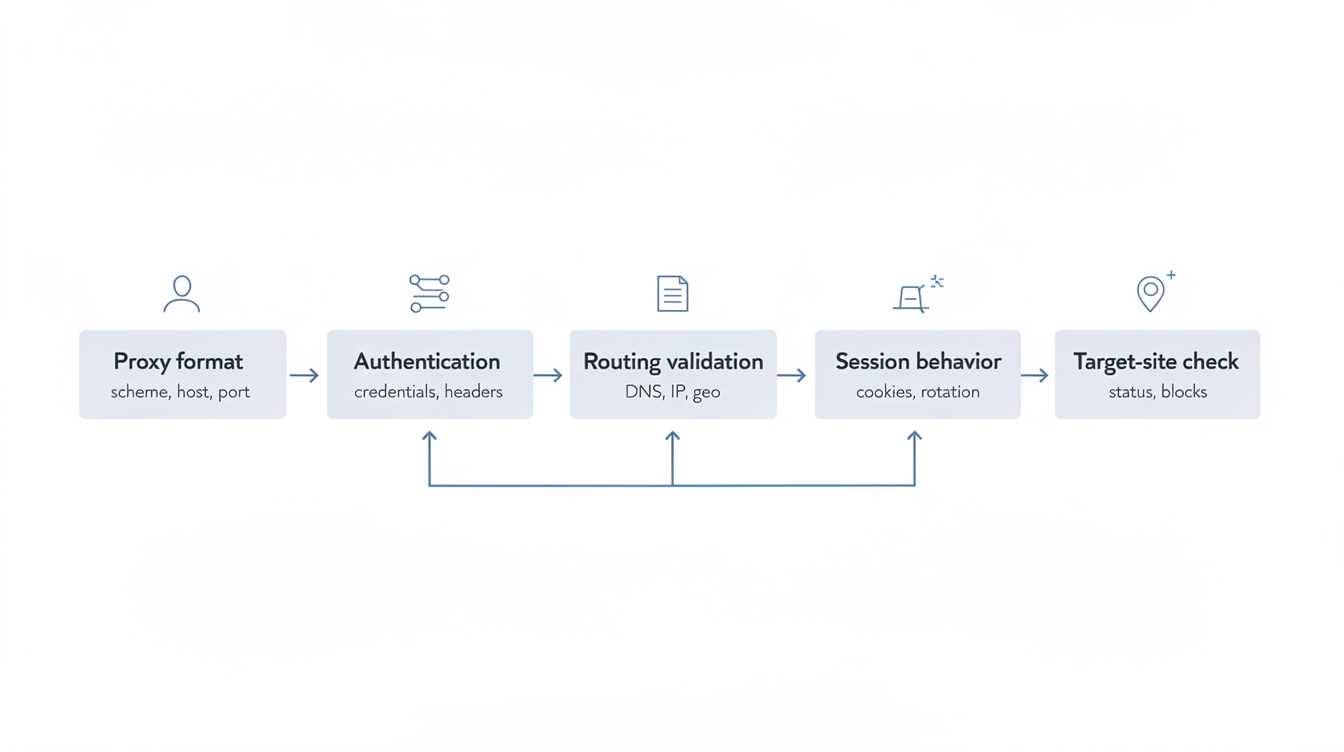
Use this checklist before you buy an unlimited residential proxies plan or move a trial into production:
- ☐ Test concurrency at the level your workflow actually needs, not at a symbolic low thread count.
- ☐ Verify sticky-session behavior over a realistic time window.
- ☐ Check whether the same gateway remains stable during bursts and cooldown periods.
- ☐ Validate city, state, or country precision on the locations you actually need.
- ☐ Measure block rate on your real target class instead of on a generic test page.
- ☐ Ask support what fair-use review looks like and what triggers it.
- ☐ Confirm whether authentication, seat count, or IP allowlisting creates another hidden limit.
- ☐ Compare the plan against a normal rotating proxies option when your workflow values distribution more than flat billing.
If you want a tighter evaluation flow, use the live test sequence from the proxy trial checklist.
When an unlimited residential plan is worth it, and when it is not
| Situation | Usually a good fit? | Why |
|---|---|---|
| Bursty traffic with predictable budget pressure | Yes | Flat or simplified billing can reduce planning friction |
| Moderate scraping where thread count is controlled | Yes | The main benefit is cost predictability, not infinite scale |
| Long-lived sticky login sessions | Maybe | Only if session TTL is clear and stable in practice |
| High-concurrency collection across many workers | Often no | Concurrency or gateway limits usually become the true bottleneck |
| Tight city-level verification or ad QA | Maybe | Works only if the region pool is deep enough where you need it |
| Operators who want zero policy surprises | No | “Unlimited” marketing still needs explicit fair-use language |
This is also where sticky session vs rotating proxy matters. If session continuity is the real requirement, the billing label matters less than the session behavior.
A simple decision path for buyers
- Start with the provider’s pricing page and confirm whether the offer is truly different from a standard bandwidth model, or only renamed. For example, compare the stated scope with the published unlimited residential proxies pricing.
- Ask three direct questions before paying: what is the real concurrency ceiling, what session duration is typical, and what fair-use action happens under sustained load.
- Run a small pilot with your real targets and realistic concurrency.
- If billing becomes simpler and the plan survives the pilot cleanly, the unlimited offer may be worth it.
- If the pilot fails because of throughput, unstable sessions, or vague support answers, choose a clearly scoped plan instead of trusting the label.
Final takeaway
Unlimited residential proxies can be a useful buying option, but they are rarely a blank check for every workflow.
Treat “unlimited” as a pricing hint, not a performance guarantee. If the real concurrency, session, geo, and fair-use behavior match your workload, the plan can be a good fit. If those boundaries stay vague, the safer move is to keep looking.