Sticky Session vs Rotating Proxy: Which One Actually Fits Logins, Scraping, and QA?
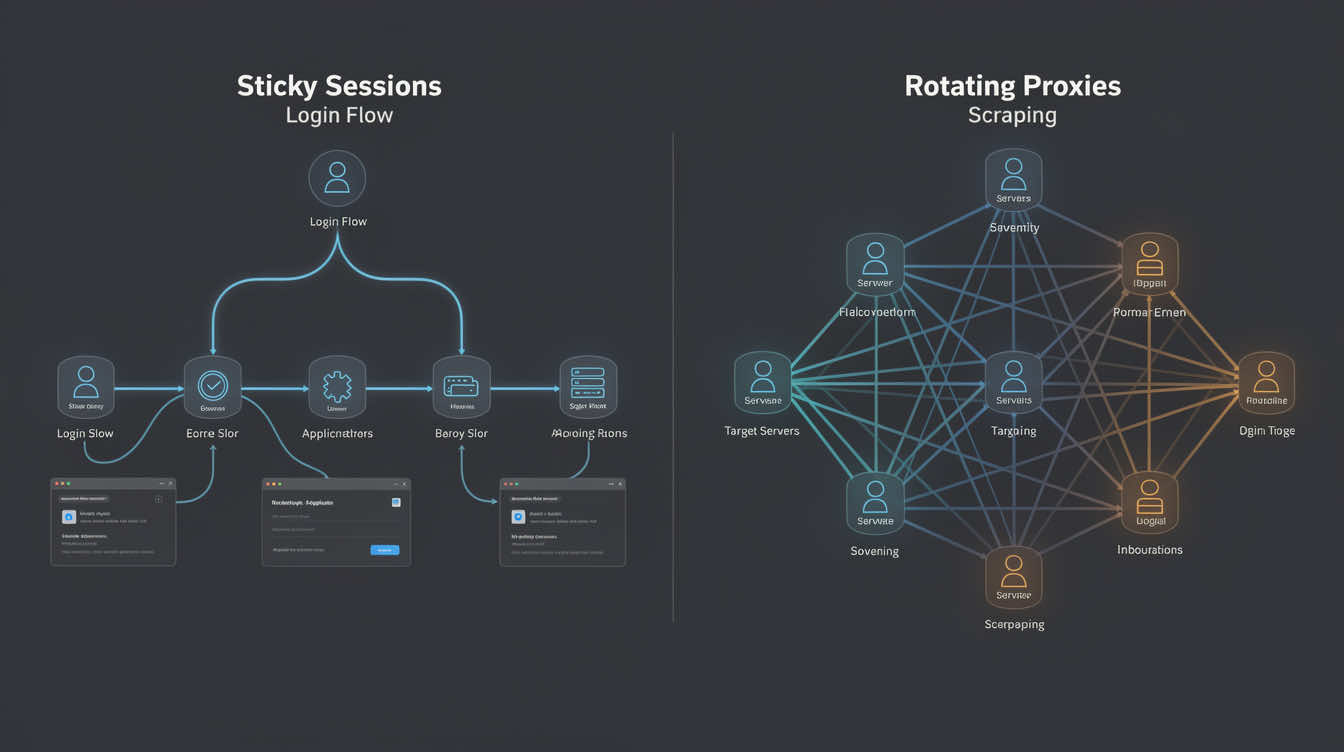
Teams often compare sticky sessions and rotating proxies as if one is simply more powerful than the other. In practice, that is the wrong question. The real question is which session model fits the workflow you are trying to run.
If you need continuity across a login, dashboard flow, cart, account action, or multi-step browser sequence, a rotating proxy can make a healthy setup look broken. If you need broad, stateless collection across large URL sets, a sticky session can be slower, more expensive, and less useful than you expect.
That is why the better comparison is not “which one is better?” but “which one breaks less for this exact job?”
The short answer
Use a sticky session when the workflow needs one stable identity for a meaningful period of time.
Use a rotating proxy when the workflow is broad, stateless, and benefits more from distribution than continuity.
Everything else in this article is about making that decision correctly before you waste time debugging the wrong setup.
What a sticky session actually solves
A sticky session keeps requests pinned to one exit IP for a defined session window. That matters when the target system expects continuity.
Typical sticky-session workloads include:
- login flows
- account management
- carts and checkout testing
- multi-step browser automation
- dashboards and operator workflows
- any task where cookies, state, or reputation need to stay consistent long enough to finish the job
The value of sticky behavior is not that it sounds more stable in theory. The value is that the target sees one coherent identity path for long enough to complete the workflow.
If the target expects one user to move through several connected actions, aggressive rotation often creates avoidable instability.
What rotating proxies actually solve
A rotating proxy changes the exit IP by request, by time window, or by session logic. That makes it useful when the workflow is not trying to preserve one identity.
Typical rotating-proxy workloads include:
- large-scale public-page scraping
- broad URL discovery
- catalog collection
- SERP collection
- market monitoring across many independent requests
- workflows where wider distribution matters more than continuity
The value of rotation is not “more movement is always better.” The value is spreading requests across identities so one endpoint does not carry too much visible pressure.
If each request can stand on its own, rotation often fits better than trying to hold one route steady.
The wrong choice creates fake proxy problems
A lot of proxy complaints are really session-model mistakes.
Examples:
- A team uses rotating proxies for a login-heavy Selenium run and blames the provider when the site keeps challenging the session.
- A scraper uses sticky sessions for broad catalog collection and then wonders why block pressure builds too quickly.
- QA tries to reproduce a region-specific issue with uncontrolled rotation, then cannot tell whether the bug changed or the identity changed.
In all three cases, the proxy may be technically working. The workflow is what is mismatched.
That is why session choice belongs near the start of the decision, not at the end of troubleshooting.
Use sticky sessions for continuity-heavy work
Sticky sessions are usually the better fit when the target behavior depends on identity continuity.
Best-fit cases
- browser automation that spans several pages
- logins that should not change IP mid-flow
- carts, forms, and checkout testing
- account operations
- dashboards and session-based tools
- support, QA, or monitoring flows where repeatability matters more than distribution
What goes wrong when you rotate too early
If the IP changes during a continuity-heavy flow, you can trigger:
- repeated logins
- step-up verification
- broken session trust
- anti-fraud checks
- inconsistent cookies and state handling
- false negatives during QA
That often looks like “the proxy is unstable” when the real issue is that the session model is too aggressive for the workflow.
If the work needs a stable identity path, compare sticky behavior with more stable options such as static proxies.
Use rotating proxies for broad, stateless work
Rotating proxies are usually the better fit when individual requests do not need to share one identity.
Best-fit cases
- broad public-page scraping
- search-result collection
- large product/catalog collection
- large-scale monitoring across many pages
- discovery workflows where each request stands alone
What goes wrong when you stay sticky too long
If you keep one route pinned while pushing too many unrelated requests through it, you can create:
- avoidable concentration on one IP
- block pressure building faster than needed
- less realistic distribution
- weaker scaling efficiency
That can make a working proxy pool look smaller or less effective than it actually is.
If the requests are independent, a rotating proxy model often matches the workload better.
The real decision is continuity vs distribution
This is the cleanest way to decide.
Choose sticky sessions when you need:
- one stable identity for long enough to finish the task
- fewer mid-flow trust breaks
- repeatable browser behavior
- continuity for login, cart, dashboard, or form-heavy workflows
Choose rotating proxies when you need:
- broader request distribution
- lower concentration on one visible identity
- more scale across independent requests
- less dependence on one session staying alive
If you are still choosing based on provider marketing instead of workflow behavior, you are starting in the wrong place.
Browser automation usually needs more continuity than teams expect
Automation teams often underestimate how continuity-sensitive browser work is.
A browser session may carry:
- cookies
- local or session storage
- navigation state
- timing patterns
- trust signals that make more sense when the IP stays consistent
That is why a sticky session often fits browser-heavy automation better than raw rotation, especially for Selenium, Playwright, Puppeteer, QA, and login-bound workflows.
If the goal is to reproduce user behavior or maintain one logical browsing identity, rotating too aggressively is often self-sabotage.
Scraping usually needs more distribution than teams expect
The opposite mistake also happens.
A team runs a large public scraping job through a sticky session because it feels more controlled. Then they push too much volume through one identity and create pressure that a rotating strategy could have spread more safely.
If the workload is public, stateless, and large enough, distribution usually matters more than continuity.
That is why “stable” is not automatically “better.” It depends on the shape of the traffic.
QA and debugging need repeatability first
QA is one of the clearest use cases for sticky behavior.
If you are trying to confirm:
- whether a region-specific bug still exists
- whether a UI issue is reproducible
- whether a checkout or login path breaks only in one location
then uncontrolled rotation can make your debugging noisy.
You may think the site changed when the identity changed instead.
For QA, a sticky session usually gives you cleaner evidence because the route stays stable long enough to reproduce the issue.
A simple decision table
| Workflow | Better fit | Why |
|---|---|---|
| Login flow | Sticky session | Identity continuity matters |
| Dashboard work | Sticky session | Mid-session IP changes can break trust |
| Checkout testing | Sticky session | State and verification need consistency |
| Broad public scraping | Rotating proxy | Distribution matters more than continuity |
| Large URL discovery | Rotating proxy | Requests are mostly independent |
| QA reproduction | Sticky session | Repeatability matters more than spread |
| Large monitoring across many pages | Rotating proxy | Lower visible concentration |
When to mix both
Some teams should not choose one model globally. They should split the workflow.
For example:
- use rotation for discovery or collection
- switch to sticky sessions for sensitive browser flows
- keep a more stable path for login, checkout, or account actions
This is often the most practical design. One part of the workflow needs distribution; another part needs continuity.
The best question to ask before buying or debugging
Before you choose sticky or rotating, ask:
Does this task need one stable identity, or does it need broader request distribution?
That question will get you farther than generic claims about speed, safety, or anonymity.
If the workflow needs continuity, start with sticky sessions and consider whether static proxies are the cleaner long-session choice.
If the workflow needs scale across independent requests, start with rotating proxies.
FAQ
Are sticky sessions better than rotating proxies?
Not in general. Sticky sessions are better for continuity-heavy workflows. Rotating proxies are better for broad, stateless distribution.
Should I use rotating proxies for logins?
Usually not if the login flow depends on one stable identity across several steps.
Are sticky sessions good for scraping?
They can be, but mostly for continuity-sensitive scraping. For broad public collection, rotation is often a better fit.
What is the biggest decision factor?
Whether the workflow needs continuity or distribution.
Final takeaway
Sticky sessions and rotating proxies solve different problems. Sticky sessions are usually better for continuity-heavy workflows such as logins, dashboards, checkout testing, and repeatable QA. Rotating proxies are usually better for broad, stateless work such as large-scale scraping, discovery, and distributed monitoring.
If you choose the wrong session model, the proxy can look broken when the real issue is simply that the workflow and the session behavior do not match.