
 Rotating Residential Proxies
 Rotating Datacenter Proxies
 Static Residential Proxies
 Static Datacenter Proxies
 Unlimited Rotating Residential Proxies
 Proxy Solutions
 United States Proxies
 Canada Proxies
 United Kingdom Proxies
 France Proxies
 Germany Proxies
 Singapore Proxies
 Japan Proxies
 Australia Proxies
 Vietnam Proxies
 Philippines Proxies
 India Proxies
 Mexico Proxies
 View All Regions
 Social Media
 E-commerce
 Data Aggregation
 Ad Verification
 Artificial Intelligence
 Market Research
 Integration Tools
 Contact Us
 FAQ
 Documentation
 Tutorials
 SDK
 Affiliate Program
 Become an Agent
 Partners
 Blog


Proxy DNS NXDOMAIN vs SERVFAIL: Separate Client, Resolver, and Route Failures
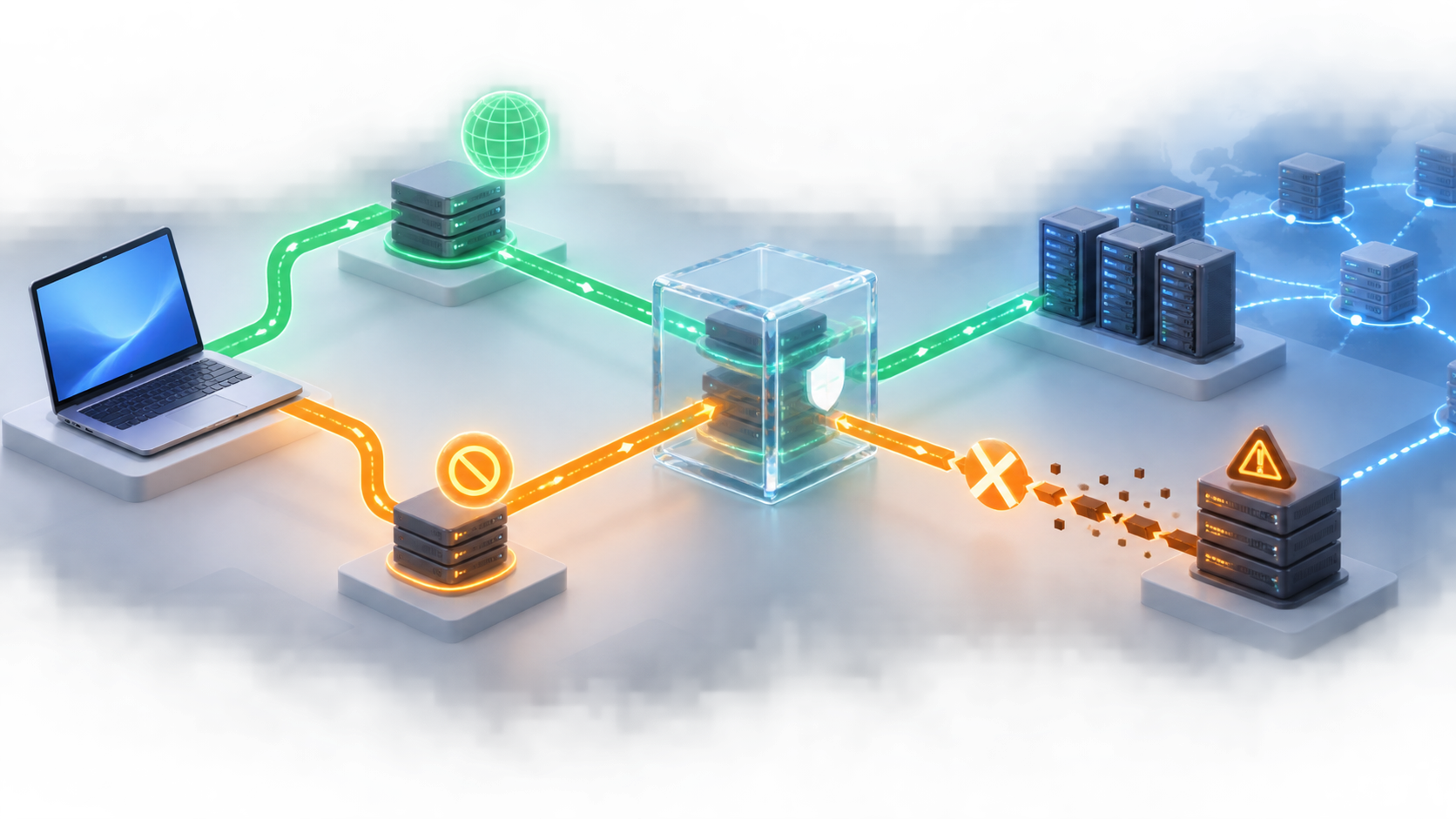
When a hostname fails only through a proxy path, the error is not always a bad proxy. NXDOMAIN means the resolver concluded that the requested name does not exist. SERVFAIL means the resolver could not complete a valid answer. The first task is to identify which resolver produced the result and whether the client resolved the name locally or delegated it through the proxy.
Keep the hostname, record type, client, proxy endpoint, test time, and network route fixed. Capture the exact DNS result before clearing caches or changing resolvers. Do not substitute a guessed IP address for a hostname that uses TLS, virtual hosting, or region-aware routing; that can create a different failure and hide the original evidence.
Classify The DNS Result Before Changing Routes
| Observed result | What it usually means | First evidence to capture |
|---|---|---|
| NXDOMAIN | The active resolver says the queried name does not exist | Exact hostname, query type, resolver, response code, and authority section |
| SERVFAIL | The resolver could not validate or complete an answer | Resolver, DNSSEC status, delegation path, timeout, and retry behavior |
| NOERROR with no address | The name exists but has no record of the requested type | A, AAAA, CNAME, and authority results |
| Timeout | No DNS response arrived within the client budget | Resolver address, transport, elapsed time, and packet path |
| REFUSED | The resolver declined the query | Resolver policy, source network, recursion setting, and query type |
| Local answer differs from remote answer | Resolver view, cache, region, or split-horizon policy differs | Both answers, TTLs, resolver identities, and exit route |
Identify Whether DNS Is Local Or Proxy-Side
An HTTP proxy normally receives a hostname in the request and may resolve it upstream, while a client can still perform local lookups for other operations. SOCKS clients can resolve locally or send the hostname for remote resolution depending on the scheme and library. Record the configured proxy URL, client documentation, and whether the connection request contains a hostname or a numeric address.
Use the local and remote DNS comparison to verify how the client treats SOCKS5 and SOCKS5H. Do not infer remote resolution merely because a proxy is enabled in the interface.
Confirm The Exact Hostname And Query Type
Copy the hostname from the failing request and check for trailing dots, invisible characters, misspelled labels, environment suffixes, and accidental URL components. DNS accepts names, not full URLs. A query for https://example.test/path is not equivalent to a query for example.test.
Query A and AAAA separately. A name can exist with only one address family, so a blank AAAA answer is not automatically NXDOMAIN. Record CNAME chains and the point where a chain becomes invalid.
Compare One Known Resolver With The Active Resolver
Run the same low-risk query against the resolver actually used by the client and one approved control resolver. Record the response code, returned records, authority data, TTL, DNSSEC flags, and elapsed time. A public control resolver is evidence for comparison, not an automatic production replacement.
If both resolvers return NXDOMAIN with the same authority, verify the hostname and authoritative zone. If only one resolver fails, examine its cache, forwarding path, policy, and reachability. Keep the proxy route fixed during the comparison.
Inspect Negative Caching And TTL
Resolvers can cache NXDOMAIN and other negative answers. Record the authority section and negative TTL when available. A recently created or corrected record may still fail through one resolver until the negative cache expires, while another resolver already returns the new answer.
Do not clear every device and resolver cache at once. Test one fresh approved resolver or client, then change a single cache layer. A pass after the documented TTL expires supports a stale-negative-cache diagnosis; a result that changes immediately with the route requires further resolver-path evidence.
Check DNSSEC When SERVFAIL Is Consistent
DNSSEC validation errors often appear as SERVFAIL rather than a detailed client message. Compare validating and non-validating diagnostic results only when authorized, and inspect delegation, DS records, signatures, time validity, and the point where validation breaks. The repair belongs with the authoritative zone or validating resolver configuration.
Do not disable DNSSEC globally to make the request succeed. A temporary diagnostic comparison must be isolated and documented. Restore validation and escalate with the failing zone, resolver, timestamp, and validation evidence.
Separate Resolver Reachability From Name Existence
A DNS timeout, blocked transport, or unreachable forwarder can be transformed by some clients into a generic resolution error. Measure DNS elapsed time separately from proxy connection and destination response time. Use the timeout layer checks to keep resolver delay, TCP connect delay, and target read delay from being combined.
If many unrelated hostnames fail through the same route, test resolver reachability and proxy-side DNS health. If only one zone fails, focus on delegation, DNSSEC, policy, and authoritative availability.
Compare IPv4 And IPv6 Without Forcing A Permanent Fix
Some clients query A and AAAA in parallel and report whichever branch fails first. Capture both responses and the selected address family. A missing AAAA record is valid when A exists, while an IPv6-only resolver path can fail if the proxy or upstream network does not support it correctly.
Use one controlled IPv4-versus-IPv6 comparison. Do not permanently disable an address family until repeated evidence shows that the failure follows that path and the application owner accepts the operational tradeoff.
Verify Route Identity And Regional DNS Views
Region-aware and split-horizon DNS can return different answers by resolver location, source network, or enterprise policy. Confirm the proxy endpoint, actual exit address, ASN, and expected region using exit IP verification. Then compare the resolver’s region with the exit route.
If an account or workflow should use a fixed route, check for unexpected endpoint changes with the route drift checklist. A different resolver view is not automatically wrong; the question is whether it matches the documented route and destination policy.
Run A Controlled Local-Versus-Remote Resolution Test
- Select one approved hostname that consistently reproduces the failure.
- Record local A, AAAA, and CNAME results with resolver identity and TTL.
- Send the hostname through one fixed proxy path that supports remote resolution.
- Capture the remote result, exit route, and final connected address when available.
- Repeat one control query for a stable public hostname.
- Stop after the smallest comparison identifies the failing resolver layer.
Use a private proxy setup audit to confirm device, browser, DNS, and route settings before changing infrastructure. Do not change the client, resolver, proxy endpoint, and hostname in the same test.
Classify Pass, Fail, Ambiguous, And Stop Outcomes
| Outcome | Evidence | Decision |
|---|---|---|
| Pass | Two controlled queries return the documented answer and the target connects normally | Resume gradually and retain the baseline |
| Hostname failure | Approved resolvers consistently return NXDOMAIN for the exact name | Correct the hostname or authoritative record |
| Resolver failure | One resolver returns SERVFAIL while an approved control returns a valid answer | Inspect forwarding, DNSSEC, cache, and resolver health |
| Route-specific | Remote resolution fails only through one fixed route | Quarantine the route and escalate with resolver evidence |
| Ambiguous | Resolver, exit, TTL, or response changes between identical attempts | Reduce the test to one stable variable |
| Stop | The name is outside the approved scope or diagnosis would require disabling security broadly | Stop and escalate to the zone or network owner |
Keep A Compact DNS Evidence Record
- Timestamp, exact hostname, query type, and client version
- Proxy protocol, endpoint, exit IP, ASN, and region
- Local or remote resolution mode and resolver identity
- Response code, records, CNAME chain, TTL, and authority data
- DNSSEC validation status and delegation point when relevant
- IPv4 and IPv6 results
- Control resolver and control hostname outcomes
- Changed variable, retest result, and stop decision
Store the comparison in the troubleshooting log. This gives client, proxy, resolver, and authoritative-zone owners the same evidence without reducing every name-resolution failure to a generic proxy error.
The Practical DNS Diagnostic Order
First identify local or proxy-side resolution and preserve the exact response. Then verify the hostname and query type, compare one approved resolver, inspect negative caching and DNSSEC, separate timeout from name existence, and compare IPv4, IPv6, and route identity. Change one layer only after the evidence points to it.
This order prevents an NXDOMAIN typo from being mislabeled as a route failure, keeps a SERVFAIL validation problem from being hidden by a resolver switch, and produces a repeatable pass, fail, ambiguous, or stop decision.